










In a world that frowns on “too many” kids, Aaron Edwards shares the joys, challenges, and biblical vision that make big families a blessing, not a burden
For an alternative perspective see here.
I am the father of a socially inappropriate volume of children. At least according to modern society. We have seven. But even when we only had three, my wife recalls being asked by her GP: “Do we need to have a conversation about contraception?”
Modern western society is not geared towards large families. I am reminded of this every time I take my children to some attraction where the “family ticket” often consists of one or two parents and two children. With such expectations for what constitutes a “normal” family, perhaps it’s no coincidence that the population of the west is currently below replacement rate. To reverse the GP’s question: “Do we need to have a conversation about childbearing?”
Christians have relatively fewer children today than a century ago, mirroring a similar decline in families beyond the Church
Former Australian cabinet minister, Bridget McKenzie, spoke at the recent ARC conference, emphasising the civilizational significance of childbearing. Speaking against the modern ideologies which overlook the biological reality on this theme, she said: “The most natural thing in the world is to make babies.” This ought to be self-evident. But for many people, it no longer is. While economic factors certainly contribute to having fewer children, there can also be fears that childbearing poses health risks, or an unwillingness to make significant lifestyle sacrifices in order to pursue it. Others have even become convinced that having more children would place a greater environmental burden on the planet.
Early on in our marriage, when people asked my wife and I how many children we’d like to have, we’d say four. After having our first, we wondered how on earth anyone could have more than one, let alone more! The first is always the hardest because it makes the biggest crater in your life. So many of your priorities instantly have to change to make room for the new arrival in your life, for whom you bear the kind of sacred responsibility that’s difficult to fully understand until you are holding that little person in your arms for the first time. You can no longer just “do things” the way you used to. This, of course, is what the “DINKs” (Dual Income No Kids) love to boast about when they post videos on social media showing couples drinking champagne for lunch or going jet-skiing or hiking at the drop of a hat, telling the childbearing fools amongst us how free and fulfilling our lives could have been if only we hadn’t burdened ourselves with children.
The Psalms not only speak of children as a blessing but even seem to imply that having numerous children is biblically normative rather than exceptional
Far from seeing Christians stand against the modern anti-natal mindset, it seems strange that many Christians seem to come under a similar spell. It’s no coincidence, for example, that Christians have relatively fewer children today than a century ago, mirroring a similar decline in families beyond the Church. When the overarching concerns about childbearing are framed in terms of the “cost” or “burden,” we start to imagine children as more of a curse than a blessing.
The Psalms not only speak of children as a blessing but even seem to imply that having numerous children is biblically normative rather than exceptional. The images tend to connote abundance: arrows in the quiver (Psalm 127:4), olive shoots around the table (Psalm 128:3), green plants and palace cornerstones (Psalm 144:12). It would be hard to read the Psalms and conclude that God wants us to be especially careful not to have “too many” children! Abundant childbearing seems to have civilizational significance for human flourishing, that we would indeed “be fruitful and multiply” (Genesis 1:28; 9:1) and receive the “heritage of the LORD” (Psalm 127:3) with a multi-generational imagination which extends to “your children’s children” (Psalm 128:6).
This doesn’t mean one should not think about stewardship, of course. Abundance is not limitless
This doesn’t mean one should not think about stewardship, of course. Abundance is not limitless. Those who think one should have as many children as is biologically possible may also be missing the point if they see the “blessing” of children as automatic without seeking to raise those children “in the fear and nurture of the Lord” (Ephesians 6:4). I hope we are raising our children to be a blessing to the world, not a curse upon it. We want them to bless our neighbours. That’s why I take them along with me when giving out evangelistic tracts or making cakes or singing old hymns and psalms to elderly neighbours. That’s why we raise them to appreciate beauty, excellence, goodness, truth, and nobility (Philippians 4:8), and to love one another with a pure heart (1 Peter 1:22).
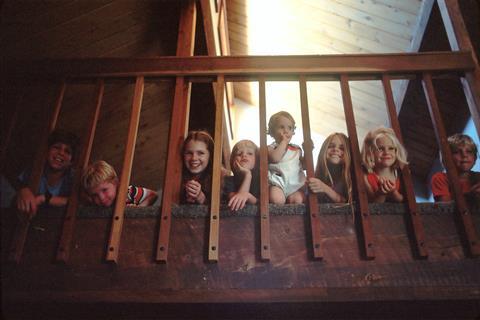
It is certainly quite the sight to walk along the street with a carousel of children bouncing along beside you. Sometimes people stare, almost shocked that such a thing is still possible in the modern world. Older people seem especially delighted to see it. Middle-aged folk regularly tell us they wish they’d had more children, some feeling they left it too late, having prioritised their careers or other pursuits without realising they would one day regret it. They recognise that children are indeed a blessing.
a large family is arguably the very best way to help children develop social skills
I would be lying if I said there were no challenges of large families, of course. This includes sibling squabbles (naturally!), and many unexpected inconveniences. But none of them outweigh the joy of the blessing. What often gives me the greatest joy as a father is to hear all the children together laughing hysterically about something silly, where age differences momentarily give way to a tidal wave of unadulterated joy. I also love to hear them pray, and to listen to them singing psalms and practising harmonies together, even if sometimes chiding each another’s mistakes with a little too much zeal!
Far from being too isolating or socially restrictive, a large family is arguably the very best way to help children develop social skills. A family is a microcosm of society. What you learn within your familial household—whether via imitation or rebellion—you will replicate in the world beyond it. With more children, comes more responsibility, not just for the parents but for the children too, who learn what it means to be part of something beyond themselves, and to love others as they would wish to be loved.
no faithful Christian parent, when they come to the end of their life, is ever going to think, “I wish I hadn’t had quite so many!”
While we don’t have an exact biblical figure for the ideal amount of children, the aforementioned psalmists’ images are unmistakeably plural, implying that you ought to at least attempt to have enough children to have your hands full. In the mystery of providence, such things are not fully “in our hands”, of course, and yet God gives us responsibility as stewards of the earth, to go forth and multiply while also tending to the garden we’ve been given. It’s not just about “having” children in faith, it’s about raising them in faith. That’s when the adventure really begins! Seasons of life can change, and there are times when having a larger family may feel especially challenging. But by God’s grace, your capacity grows with the increase, and over time you cannot imagine what life would be like without those “additional” children. It should go without saying that no faithful Christian parent, when they come to the end of their life, is ever going to think, “I wish I hadn’t had quite so many!”
Read more:
Keir Starmer is right - Being a dad and a husband is the most important job he’ll ever do
I know several Christian couples who cannot have children and wish they could. Others left it too late and could only manage one by a difficult, expensive, even morally ambiguous IVF process. The majority of Christian parents certainly could have more children but fear being outnumbered, or of the inconvenience of returning again to “the nappy stage” from which they once graduated! Many also find it hard to imagine cutting back on certain luxuries which have come to seem like necessities. There seems to be an unspoken myth that you need to be wealthy in order to have many children. But if this was so, the Psalms would seem to be quite cruel promises for the majority of the world’s population who are not wealthy. If you live as those Psalms call you to, where you do not fear, say, the loss of two incomes, but rather fear the Lord and walk in his ways (Psalm 127:1), you will not only be well provided for, but you will not be ashamed before the world (Psalm 127:8). Alongside the many challenges, you’ll certainly have a lot of fun along the way, and you will indeed be blessed.
For an alternative perspective see here.






















No comments yet