








As the world marks Holocaust Memorial Day, Jenny Sanders encourages parents to talk honestly with their children about history, faith, and forgiveness, using stories like Anne Frank and Corrie ten Boom to spark meaningful conversations
Today is Holocaust Memorial Day. It will be marked as day of remembrance including reflective services as we remember this dark period of European history. Schools may mark the day with special assemblies, readings and workshops. There are over 220,000 survivors still alive today, although the majority of these will pass away over the next decade. Their stories will die with them unless they can be recorded and passed on.
However, it’s now over eighty years since the end of World War 2. Is it too long ago to make a meaningful connection with our children?
History shows us that some stories/events have themes that never grow old
History shows us that some stories/events have themes that never grow old. In light of the old adage that history repeats itself because no one listens the first time, and some of the events unfolding across the world stage that feature in our news feeds, particularly the rise of anti-Semitism, marking the day will provide a natural platform for talking about these issues.
27th January was officially chosen as Holocaust Memorial Day by the United Nations General Assembly in 2005. It’s the date on which the notorious concentration camp Auschwitz-Birkenau in Poland was liberated in 1945 by allied soldiers of the Soviet Red Army. By then over 6 million Jews had been slaughtered in multiple Nazi gas chambers, shot, starved or killed by diseases which spread rapidly in such cramped conditions. The Allies were horrified by what they found in the camps they discovered: mass graves, emaciated captives and brutality on a scale they were unprepared for. Before the diagnosis of PTSD, it soon became clear that many of the soldiers experienced psychological damage and ongoing trauma from what they witnessed.
Read more:
Christian parents can combat worry with the truth that their children belong to God
Why Christian families need everyday faith, not new year’s resolutions
As parents, you know your children better than anyone so you can talk to them with appropriate sensitivity and insight according to the mental and emotional wiring and maturity of each child. Finding out what, if anything, your child’s school intends to do to mark the day will help you prepare them for the conversations and discussions that will arise. Talking gently about some of the terrible things that happened during the war itself may help with understanding tragedy.
Here are two tools that may help you:
1) Anne Frank’s Diary
When Anne turned thirteen, she was given a blank notebook which she decided to use as a diary. She had no idea that its 330 hand-written pages would one day be published by her father, nor that it would be translated into over 70 languages. I read it when I was ten or eleven years old, not much younger than Anne. It had a huge impact on me at the time as I tried to wrap my head around the atrocities I was beginning to discover associated with the Second World War. Processing horrors that were so beyond my experience was impossible, but understanding the reality of hiding in an attic with my family and friends for two years was more manageable.
My interest at the time was boosted by a Blue Peter report in which presenter Valerie Singleton visited the Frank’s hiding place in Amsterdam. I vividly remember how she swung open a bookcase to reveal a door with stairs up to the annexe, as well as how no one was allowed to flush the loo during the day in case the factory workers below heard the plumbing at work and realised they were there.
Themes of friendship, betrayal and the true meaning of freedom will be natural avenues of family discussion
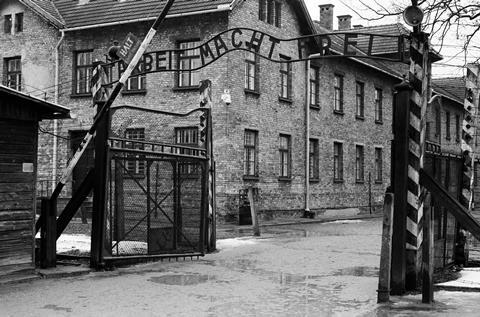
The family were betrayed to the Nazis and discovered in August 1944. They were taken to the Auschwitz-Birkenau concentration camp where the famous motto written in German over the gate read: Arbeit macht frei – ’Work makes you free’. Anne and her sister, Margot were later transferred to Belsen camp where they both died.
Her diary was first translated and published in English in 1952 and is still a worthwhile read. Perhaps you could read it as a family. You could also watch this BBC interview with Anne’s father, Otto from 1976. Themes of friendship, betrayal and the true meaning of freedom will be natural avenues of family discussion. Full of hope, Anne wrote in her diary,: ‘I want to go on living after my death! And therefore I am grateful to God for this gift, this possibility of developing myself and of writing, of expressing all that is in me. I can shake off everything if I write; my sorrows disappear; my courage is reborn.…’ In many ways she has lived on through her writing. How might we adopt the same attitude that Anne had? How can we cultivate gratitude in difficult circumstances and model it for our children?
2) The Hiding Place - Corrie ten Boom
Corrie ten Boom was the grown-up unmarried daughter of a Dutch watchmaker who hid Jews from the Nazis when the Netherlands were under German occupation. She and her sister, Betsie, joined the Dutch underground in 1941. A secret room was built behind a false wall in the house a year later, where many took refuge. The Gestapo raided the home in February 1944, arresting the family. Corrie and Betsy were both sent to Ravensbrück women’s concentration camp 56 miles north of Berlin where medical experiments were routinely carried out on inmates, masterminded by the notorious Josef Mengele.
Though established for 6,000 women, by the end of the war Ravensbrück held 36,000. Betsie died of starvation there in December 1944 while Corrie endured several months of solitary confinement before being released thanks to what she always thought must have been a clerical error combined with the mercy of God. Days later, the other women her age were gassed – the camp was finally liberated four months later.
Ask the Holy Spirit to help your family draw out truths from this Memorial Day to apply in your lives and help you move deeper in authentic faith, reflecting Jesus as you go
Years passed and Corrie was in demand as a Christian speaker taking about her experiences, steadfast faith and the goodness of God in dark places. A famous story tells how at the end of one such meeting one of the ex-prison guards greeted her with joy at how Jesus had washed his sins away. The man wanted to shake her hand but Corrie found herself paralysed when he wanted to shake her hand. Her inner struggle to forgive in the same complete way she knew she had herself been forgiven by God is searingly honest: I felt nothing, not the slightest spark of warmth or charity. And so again I breathed a silent prayer. Jesus, I prayed, I cannot forgive him. Give me Your forgiveness.
As she eventually took his hand, Corrie experienced something akin to electricity pulsing through her arm. I discovered that it is not on our forgiveness any more than on our goodness that the world’s healing hinges, but on His. When He tells us to love our enemies, He gives, along with the command, the love itself. It’s a profound revelation that will provoke animated discussion.
Both these resources will stir insightful questions for family discussions around the themes they carry. Ask the Holy Spirit to help your family draw out truths from this Memorial Day to apply in your lives and help you move deeper in authentic faith, reflecting Jesus as you go.