









Distraction is the new epidemic which is why Sarah Wilks urges families and churches to create space for God by setting boundaries on smartphones and reclaiming real-life community
For an alternative view see here.
“Our smartphones, tablets, and computers have become sources of constant distraction, fragmenting our focus and preventing us from giving others the undivided attention that relationships require. We sit together in the same room while our minds are scattered across dozens of apps, notifications, and feeds. We’re physically present but mentally absent, unable to fully engage with the people right in front of us” (Catherine, The Princess of Wales).
The Princess acknowledges there are many benefits of technology, but that we cannot ignore the complexities and risks of possible harm. Her focus is on human connection, particularly between children and their parents, and her concerns about screens are echoed by professionals.
Health teams are worried about links to mental health disorders, and physical health impacts on eyesight and brain development. School leaders cite problems of excessive screen use on school readiness, educational attainment, behaviour and speech. Social workers are ringing alarm bells for criminal exploitation and sexual harms via smartphones.
It was disheartening to see a room full of young people, at an event relevant to their stage of life and aimed specifically at their age group, but so disengaged
But for Christian families, there is another added dimension to consider. Is it possible that smartphones might be impacting on our children’s emerging faith and spiritual development?
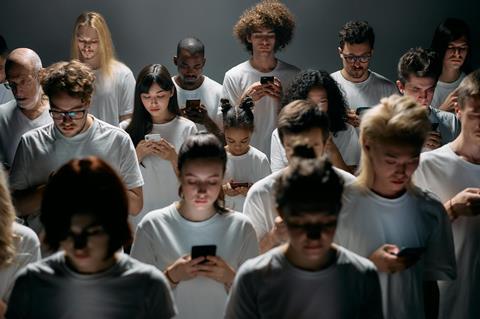
This is a question I have wrestled with after I attended a regional youth event with my twelve-year-old daughter. I sat at the back with her and spotted a row of six girls who looked a similar age. Almost as soon as the event began, these girls took out their smartphones and they remained seated throughout the sung worship, fully absorbed in their individual screens. Occasionally they interacted, but only to show someone next to them a video.
we shouldn’t use smartphones during Sunday services. This models good habits to young people and allows us all to have space to hear God’s voice
Sitting where I was, I could see they weren’t absorbed in a Bible app or making notes, instead they were scrolling through endless short form videos, switching to games, or onto messaging platforms. They missed the worship time, hosted interviews, preaching, and final responsive worship time. And they weren’t alone; I could see others throughout the venue also getting their phones out to zone out of the room.
It was disheartening to see a room full of young people, at an event relevant to their stage of life and aimed specifically at their age group, but so disengaged. How can they be open to Jesus, to make decisions about faith for themselves, if they are physically in the room, but emotionally and mentally absent? And how much worse is their disengagement in a very normal weekly Sunday church experience?
Can you spare 5 minutes to help Premier NexGen? Answering this short survey will help us make our great content for Christian parents even better
In the last ten years it has become a cultural norm for children to be given smartphones during primary school. Through our own research as parents, my husband and I realised that smartphones were not a safe option for children or young people, so we opted out. We bought a non-smartphone for our daughter. I am a GP and what I learned initially as a parent, now informs my clinical practice. I also deliver parent education sessions, through an organisation called Papaya.
These sessions aim to inform families of medical research and, regardless of whether a parent opts to buy a smartphone or delay it, encourages parents to question the cultural norm as they make their informed choice. But as I deliver this content in non-Christian contexts, I never mention the impact on spiritual health. Attending that youth event, I now question cultural norms in church and how we model good digital wellbeing to young people. I have personally concluded that, as adults, we shouldn’t use smartphones during Sunday services. This models good habits to young people and allows us all to have space to hear God’s voice.
we all need to learn the skills required to sit and wrestle with the big questions of life. Smartphones cut right across these skills
For good physical health, we need to choose the right foods and to exercise. For good spiritual health we are also required to make choices. Reading the Bible, and prayer, are a starting point and both require us to practice skills in order to hear God’s voice, and to learn more. American author John Mark Comer says “It’s not that people don’t want to become like Jesus… it’s that we don’t know how to become like Jesus.” He goes on to outline eight spiritual practices, including solitude, sabbath and service. Young and old, we all need to learn the skills required to sit and wrestle with the big questions of life. Smartphones cut right across these skills. They fill every available moment with noise of some sort, with those aged 15-24 spending nearly 5 hours a day on their phones.
A common argument of the positive aspect of smartphones is to consider the value of the communities that young people build online, which can be accessed at any time, and can include faith-based communities. But while social media promised to connect us all, in reality, we have never been more isolated. A 2024 government survey showed that those aged 16 to 24 were more likely to report that they felt lonely often or always, more than any other age group.
just because a community can bring a sense of belonging, it does not mean these are positive communities
Besides risking disconnection, we also need to remember that just because a community can bring a sense of belonging, it does not mean these are positive communities. Spiritual abuse experienced anywhere is extremely harmful and must be safeguarded against online, as well as in the real world. The focus for our young people in church should be connecting them in real life.
Others will argue that Bible apps help people access scripture more readily. I agree, it is easier to access when I’m out and about, but when I use my physical Bible for study, the only distractions are my own thoughts. When I use an app-based Bible, everything on my phone is a distraction too. Even if messages are off, or the phone is in flight mode, just looking at the screen at my various apps reminds me I need to do my supermarket shopping or top up the school dinner money.
Using a smartphone during a church service is a distraction for all of us, but for young people to stay focused is a developmental challenge
The prefrontal cortex, the part of your brain responsible for decision making and impulse control, doesn’t fully mature until your twenties. Using a smartphone during a church service is a distraction for all of us, but for young people to stay focused is a developmental challenge.
For Christian parents considering smartphone cultural norms, we now need to consider challenging the assumptions that have slipped into our churches. Leadership teams should be encouraged to consider what they want their screen culture to be. This can never be absolute as we welcome new people each week, but regular attendees can create a positive cultural space with adults leaving smartphones at home, modelling use of a Bible and notebook, or a church wide digital fast.
Read more:
No social media ban for kids say MPs - So what now for Christian parents?
Why this Christian son thinks social media bans for under 16s will fail
Why this Christian dad welcomes the social media ban for under 16s
I believe children and toddler groups should be screen free entirely. But youth groups should engage their teenagers in this. For young people experiencing cyberbullying, smartphone or social media addiction, or being regularly exposed to dark content, it may come as a relief to have an entirely screen free space available to them. Harry Styles’ recent ‘One Night Only’ concert banned smartphones in order for fans ‘to enjoy the show fully and be fully immersed in the experience.’ As stars lead the way, we can hope this generation appreciates authentic real-world opportunities, including learning about Jesus, and responding to the Holy Spirit.
For an alternative view see here.