









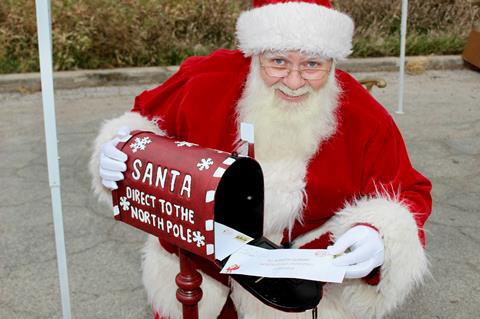
Lisa Skinner thinks that having Santa as part of Christmas traditions is a fun way to engage children’s imaginations and to help them be in the world but not of the world
For an alternative view see here.
I believe that the way we parent is shaped heavily by how we were raised, both the parts we cherish and the parts we choose to do differently. So, when I became a parent, there was never any question that Santa would be part of our festive traditions.
Each year we have the build-up: letters are penned to the man in red in late November; two items can be requested and if Santa leaves a few surprises (which he always does), well, that’s a bonus. There is also an understanding that mum and dad send money to Santa to help cover the expense of the toys, so there is a limit to the budget.
Even as we enjoyed the fun and imagination of Santa, we always keep Jesus at the centre of it all
On Christmas Eve, treats are left out on the kitchen table for Santa and his reindeer. Stockings are placed on each child’s designated sofa, and in the morning they’re found brimming with treats, and surrounded by a joyful scatter of presents, some from Santa, some from family and friends. The tone is set for a day of joy and celebration.
Our children have always accepted that this is what Christmas looks like. We usually make one visit to see Santa before the big day, but even then they understand that he is only a helper—a stand-in for the real man, who is far too busy preparing for Christmas Eve.
For us, Santa never pulled our focus away from what Christmas really celebrates
Of course, that lovely innocence doesn’t last forever. Three of my four children are now among the gatekeepers of the secret. With the first two, I took each of them for a coffee date after Christmas, once they turned nine, to have ‘the chat.’ I was conscious that their more worldly classmates might spoil it first, or worse, tease them the following year. I worried about how they might take it, would they feel deceived? Would it damage the trust between us? But each time, their response was the same: quiet acceptance and a kind of gratitude for everything we’d done to make the tradition so magical.
My third child, however, was ahead of the curve (as third children tend to be). She had figured it out long before we ever sat down for the conversation, but decided to keep playing along, just in case.
We are also conscious of not isolating our children from their peers
For all three, the magic of Christmas didn’t end with the Santa story, because that was never the source of the magic to begin with. Even as we enjoyed the fun and imagination of Santa, we always keep Jesus at the centre of it all. Our Jesse Tree advent devotions, the nativity plays, the live re-enactments, and the carol services, all of it gently pointed the children back to the true meaning of Christmas: God taking on human flesh and coming to live among us.
I know many Christians will differ on their views of Santa, and each family must decide what sits right for them. For us, Santa never pulled our focus away from what Christmas really celebrates. We didn’t get caught up in the idea that his name is an anagram of ‘Satan,’ nor did we see any harm in incorporating a character inspired by Saint Nicholas—a fourth-century Greek bishop remembered for his generosity. His inclusion in our festivities helped reinforce a generosity that expects nothing back: gifts offered freely, and the joy that comes from blessing others.
Read more:
10 Christmas gifts that strengthen your teen’s discipleship
Christian parents should think twice about Father Christmas’ naughty and nice list this Christmas
10 Christmas tips for Christian parents on a budget
How Christian parents can help young people navigate Christmas stress
Imagination can prepare our hearts to grasp deeper truths, a tool used brilliantly by J.R.R. Tolkien and C.S. Lewis to help readers understand biblical realities. And believing in something unseen is, after all, what our faith is founded on. There’s such a small window in childhood when imagination is effortless, when believing that one man and his reindeer can fly around the world in a single night delivering gifts to every child feels perfectly reasonable. Yes, we occasionally joked that poor behaviour might result in a lump of coal, but every parent reaches for a playful threat now and then.
We are also conscious of not isolating our children from their peers. We’re called to live in the world but not be of it, and that balance can be delicate. Making children stand out simply for the sake of standing out rarely helps them connect. Paul wrote that he became ‘all things to all men’ so that he might win some, and if Christians are only ever known for being rigid or strange, how can we hope to reach anyone? We are meant to be different, but not in a way that alienates us or our children from the world we’re called to engage with.
Whether we do it through Santa or as parents and caregivers, the desire to give our children good gifts comes from God’s own character, in whose image we are made. We give because we love, and because we are shaped by the One who gave the greatest gift of all - his one and only Son. Let that be the wellspring of our Christmas joy, this year and every year.
For an alternative view see here.