








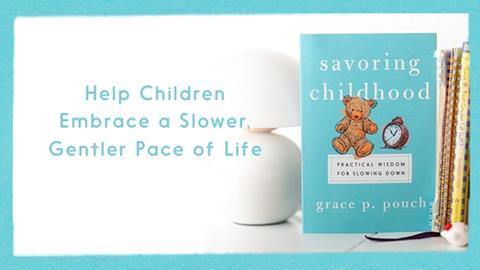
Ali Campbell thinks that Grace Pouch’s Savouring Childhood gives Christian families great practical wisdom and faith-filled encouragement to resist the rush and rediscover joy in the slow moments
When I google John Mark Comer’s book, The Ruthless Elimination of Hurry, what pops up on my screen is ”As Fast as Next-Day with Prime”. I don’t need to wait very long to read a book about slowing down.
Savouring Childhood helps us to see that we can set a pace for our children that is slower, more intentional, more lifegiving
It’s indicative of the world we inhabit where everything is immediate, whether that is binging a whole TV series on the day it is released or the fact that animated summer blockbusters are two a penny and are thrown at us all year round. The challenge, when we are parents, is whilst many of us have seen this wave of the ‘instant’ build over time, our children are thrust into the maelstrom from birth!
Savouring Childhood helps us to see that we can set a pace for our children that is slower, more intentional, more lifegiving and offers both wisdom and practical steps for taking a breath and going slow.
Going slow with our children also means that sometimes it is slow going, and that is ok!
What I love most about the book is the reality of family life that is explored. This is not theoretical, ‘wouldn’t it be nice if’. Grace Pouch and her family try and live and breathe the advice and practices shared in its pages.
The book is divided into sections on gratification, schedules, media, consuming and growing up. It could be tempting to dive into the section that you think needs most attention - it would be schedules for me! But resist that urge. I think the first section on slow gratification sets the foundation for the sections that follow. It tackles the itch to have something now. If we can help our children grow in patience and perseverance and that waiting is a positive thing, we are getting them ready for the joys and challenges of life!
Every section is packed with practical tips, examples of what it might look like to go slow
Sometimes we might read a book, and the author has it all sorted and we are left with the feeling that, “well yes, great for you - but my family doesn’t look like that.”
Well, hold on for a moment and let this quote from the first section sink in
“perfectionism is anti-perseverance because it discounts progress” (page 42).
As the author says ‘we are involved in a wonderfully rewarding long-term project - caring for a child! So hang in there, don’t try to shortcut the hard parts. Keep the long-range view in mind’.
At the heart of the book is a desire to help our children find their way - not prescribe something that is ill-fitting to them, that takes no account of their personality and temperament
Going slow with our children also means that sometimes it is slow going, and that is ok! I’m reminded of another book, 4000 Weeks’ by Oliver Burkeman, a kind of antidote to books about trying to productivity hack our way through life. We can’t do that with our children, we have to take it one day at a time, one step at a time, one slow moment after another.
I love that the section on schedules has a focus on sabbath. Sabbath practices are not something to hope for - but something we can build in with our children; how do they experience sabbath? How do we teach it by practicing it? For every section in the book, it isn’t just about what we set in place that helps our children to go slow and savour childhood - it is also a book that challenges the kind of model we are. Looking at social media and thinking about our use, our attention, our tendency to doom scroll or be distracted from something amazing our child might be doing because our phone has pinged in our pocket and we need to attend to it immediately.
Read more:
Andy Robb’s latest book inspires kids to be generous and demonstrate God’s love for others
The new book series that helps tweenagers develop faith and character for today’s world
Every section is packed with practical tips, examples of what it might look like to go slow. With such a smorgasbord of options, you can pick what might work for your family and your context. There is a helpful acknowledgment throughout the book that children at different ages require a different level of challenge, encouragement and freedom. At the heart of the book is a desire to help our children find their way - not prescribe something that is ill-fitting to them, that takes no account of their personality and temperament.
That is key actually, and probably my main takeaway. If you slow down (not just to help your children savour childhood) and notice afresh the wonderful humans you have the joy of parenting, rushing to the next thing not only becomes secondary - but you might just enjoy the wonder not just of slowing, but stopping. Being still and enjoying right in that moment the wondrous children God has gifted you with.