









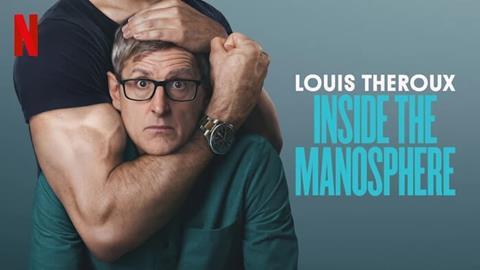
This latest offering from Netflix shows how the manosphere is shaping young minds online. In response, Martin Saunders encourages parents and churches to have open conversations with young people and model a gospel-shaped alternative
One of the most harrowing aspects of parenting is realising the kind of world your child is growing up in. Perhaps, with global instability, climate change and economic decline, those fears have never felt more pertinent or dread-inducing. Yet while they shouldn’t have to carry the burden for fixing our mistakes, at least the emerging generations offer some kind of beacon of hope. Perhaps they will be different; wiser than us? Maybe they’ll start to heal the world we’ve broken.
it’s a world of extreme online influencers and ‘content creators’ who will say anything for cash-generating clicks
If you’ve watched Louis Theroux’s new Netflix documentary Into the Manosphere, then you’d be forgiven for thinking that hope might be misplaced. For 90 excruciating minutes, the bespectacled master of embedded cringe journalism meets some of the key players in a global movement that is shaping young people – and particularly young men – in alarmingly regressive ways. Dubbed ‘the manosphere’, it’s a world of extreme online influencers and ‘content creators’ who will say anything for cash-generating clicks, and who have learned that misogyny, homophobia and brutish ‘masculinity’ are the fastest way to get them.
Through Louis’ intrepid reporting we meet Harrison Sullivan (known online by the moniker HSTikkyTokky), a muscular 24-year-old Brit known for pranks and a quick mouth, who will say absolutely anything “for the clout.” On the surface he seems to be spending his days in Marbella, surrounded by models, making outrageous videos to increase his following. In reality he’s diverting those followers to a trading app with the promise of financial transformation, and running a business making money from the OnlyFans models he promotes. Spoiler alert: when Louis invests in the app, he loses most of his money.
the most vulnerable consumers of their content are that emerging, hope-carrying generation of young people that sit around our breakfast tables, scrolling casually on their phones, taking in bite-sized chunks of influence
Then there’s his encounters with Justin Waller and Myron Gaines, two enormously successful US influencers who extol the virtues of ‘one-sided monogamy’. The former exhibits apparently dripping wealth, touting his Trump connections and preaching ultra-traditional gender roles. The latter hosts a streamed talk show in which he and a few friends verbally abuse a group of women with disgusting slurs, cheered on by an army of keyboard warriors. Like Harrison, both men boast huge online followings, all learning from their toxic examples.
As much as they like to behave as if their actions have no consequences, they sit atop a pyramid of influence. They are stopped in the street by adoring male fans; they are surrounded by women who look to some degree to be trapped or traumatised. To some extent it is possible to watch the documentary and feel a little sorry for these men as they begin to glimpse the emptiness of their endeavours. Then, you realise that the most vulnerable consumers of their content are that emerging, hope-carrying generation of young people that sit around our breakfast tables, scrolling casually on their phones, taking in bite-sized chunks of influence, day by day. They are literally being discipled.
Can you spare 5 minutes to help Premier NexGen? Answering this short survey will help us make our great content for Christian parents even better
I asked my 12 and 15 year old sons if they’d heard of the men named above, and of Sneako, the fourth subject of the documentary, infamous for being banned from almost every social media platform. The younger had come across two of them, and said that Sullivan was popular in his year group. The older was familiar with all four. These influencers aren’t reaching some imagined group of badly-behaved boys somewhere else. These voices, and their messages, are a loud reality everywhere, including homes where faith is centred.
What then do we do, when pervasive social media is teaching our boys to be brutes and our girls to be submissive? When long-term progressive cultural moves against homophobia, sexism and – terrifyingly – anti-semitism, are being rolled back instantaneously by a group of angry young men with social media know-how and an insatiable addiction to getting rich quick? Let me share just a few ideas:
-
It’s time to talk openly
Yes, it can be excruciating to try to force our way into our kids’ worlds, but the separation of their world and ours only serves to drive their engagement with harmful online spaces underground. My advice: in conversation, bring up influencers like these in a non-condemnatory way, and invite young people to share what they think; enable them to think critically, rather than simply offering criticism. This should be happening around dinner tables and in youth group sessions. When you bring something dark into the light, you deprive it of much of its power.
It is not cheesy to suggest that Jesus is the ultimate male role model; he gives us the blueprint for what non-toxic masculinity should look like
-
Better role models - on and off-line
Children and young people need trusted adults who will show them how to live and grow up better than HSTikkyTokky can. Because of the nature of adolescent brain development (which naturally pushes back against parents), mum or dad can only do so much of this. That’s why youth leaders are so important, but it also means there’s a vital place for godparents, older church members, family friends - all with the crucial caveat of safeguarding in mind - who can point the way to healthy development. There are also some fantastic Christian influencers and social media platforms to point them towards.
-
We need a bolder, braver vision for masculinity
Ultimately the greatest male role model of all time also happens to be the centrepiece of our entire faith as Christians. As well as being a perfect role model for women, Jesus also demonstrates attributes that are particularly helpful when we’re exploring healthy masculinity. As a tradesman he would have been physically strong, yet he was also emotionally engaged. He modelled healthy friendship, wrestled with his mental health and knew how to appropriately engage with women. I explore all these idea in my book for young men, The Man You’re Made to Be (SPCK). It is not cheesy to suggest that Jesus is the ultimate male role model; he gives us the blueprint for what non-toxic masculinity should look like.
Read more:
Look closer, you’ll find the first Eubank Jr - Benn fight was secretly a sermon on fatherhood
At the end of Into the Manosphere, Theroux very deliberately shows us a few clips of some of the influencers in their younger years. Having witnessed all the angry, testosterone-charged bluster of the previous hour and a half, it’s a surprisingly difficult watch. They remind us that – while now being cast as villains – these men were once innocent children too. As much as they are now the perpetrators, it is the larger culture which shaped them, and which now enables their hatred, lust, greed and every other kind of destructive sin. The solution is not simply to watch with horror, but to point our kids to an alternative worldview that is ultimately more satisfying and shaped around a very different male influencer. Let’s talk about the manosphere, let’s model something better, and let’s talk proudly about the way of Jesus that liberates all men and women.