







Sophie Killingley explains why the dinner table looks different for neurodivergent families and why true welcome is about love, not a ’picture perfect’ meal
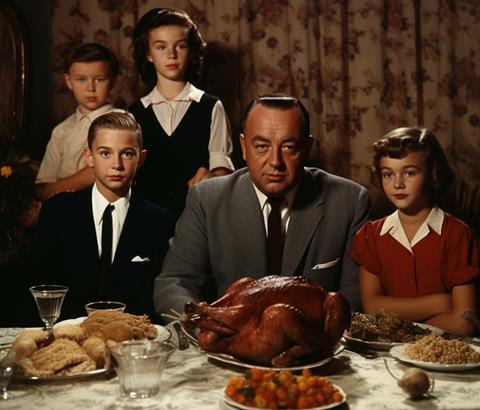
I don’t know how it happened, but somehow the biblical idea of ‘breaking bread’ and sharing food together, somehow warped into a 1950’s gravy advert. You know the type. The happy mother in an apron serving a large roast dinner with all the trimmings to her beaming children and guests while the father sits at the head of the table to lead them all in prayer.
Is having people round for food to share good? Sure! Food is a gift and a particularly special way of bonding, marking occasions and a great social leveller. There’s a reason why food and shared meals happen a lot in the Bible.
the gravy advert version of how a good Christian family practices hospitality, is the one the church has accepted
But somehow through the swathe of American evangelical tomes on parenting and church life, the gravy advert version of how a good Christian family practices hospitality, is the one the church has accepted.
And for some, that’s kind of manageable. They love having a big group round and sharing food. And brilliant! They are a gift!
But for many, especially neurodivergent families, this is not even within touching distance. And the problem comes when this inability is then used as a barometer for the spiritual health of the family, rather than a realistic look at how neurodivergent families must function to survive. Shame is piled on. And value judgements made about their value as fully integrated ‘useful’ members of the Kingdom, who take things ‘seriously’.
Now why do you suppose Neurodivergent families may struggle to engage in food-based hospitality? The reasons are myriad but first let me explain to you a couple of things about neurodivergence and food.
Neurodivergence and food
One significant part of what many neurodivergent people experience is SPD - Sensory Processing Disorder. This where the senses are somewhat scrambled. This includes sensitivity to light, to textures, to smells, to sounds.
Having too much noise, distraction or food which was unfamiliar was also a trigger for either distress or just inability to eat
When my autistic son was younger, he struggled with light sensitivity to the degree that some mornings at breakfast he would close the curtains and sit at the table wearing sunglasses, like a sad off duty rock star, in order to be able to eat. Another winter we ate mainly by candlelight as he cried in distress every time we switched the overhead light on.
Can you spare 5 minutes to help Premier NexGen? Answering this short survey will help us make our great content for Christian parents even better
Having too much noise, distraction or food which was unfamiliar was also a trigger for either distress or just inability to eat. Friends got used to the fact that even at his own birthday party, our son would need 15 mins alone in a quiet room to try and eat something.
Not the most conducive environment for having people over!
This is not the same as “being picky” or “they’ll eat when they’re hungry”
A further, more pronounced disorder which is co-occurs with autism and is present in our family is ARFID.
This is a huge and emotive topic for many. ARFID stands for Avoidant/Restrictive Food Intake Disorder - this is an eating disorder where the person is extremely selective with real fear/phobia around new or unfamiliar foods. This is not the same as “being picky” or “they’ll eat when they’re hungry.” Some children with this disorder will deny being hungry and will even become malnourished rather than eat foods which overwhelm them. The fear can be linked to sensory processing, so fear of unfamiliar textures, smells or tastes., and linked with the fear of unfamiliarity.
many parents of neurodivergent kids joke about chicken nuggets being the patron saint of autism
Consider for example a punnet of blueberries. For most of us, we accept that every blueberry will look and taste slightly differently. Some will be round, firm and sweet. Another will be round, firm and eye-squintingly-sour. And there’s always the slightly squishy one in the bottom corner. For children with ARFID, the unpredictability of taste/texture is too much.
That’s why many parents of neurodivergent kids joke about chicken nuggets being the patron saint of autism, as, by and large, they look, smell and taste the same every time!
Some children with ARFID may fear what will happen when they eat, a fear of choking, or vomiting. Some children even end up becoming seriously underweight, needing tube feeding.
It can overlap with OCD (Obsessive Compulsive Disorder) with huge, life impacting fear about food hygiene and cleanliness.
It’s worth remembering that this type of eating disorder isn’t based around body image or desire to lose weight. It’s fear of the food itself. The texture, the smell, the sight.
Now add the pressures of Christian cultural practises into the mix.
Faith and food
Have you considered that so much of our faith happens around food? Community and fellowship tend to be centred around the eating of meals whether the fun of feasting during special times in the church calendar, or the simplicity of shared meals during the week. Not forgetting the shared meal of communion. All of which are good and right!
But what I am asking here is to consider if this element of faith and community was almost impossible for you. How isolated you might feel. Alone. Defective somehow.
A very common experience of many neurodivergent families.
how about we stop attaching spiritual value based on ability to host a large group and serve plates of delicious and varied foods
And some would say, “well you’re confused between hospitality and ‘entertaining’, it can be simple!” To which I would reply, and neither of these is possible for many neurodivergent families within current expectations.
So often in ministry when invited around to others houses for food, we had to explain each time that as adults we were so happy to eat anything provided, but that I would have to bring the children’s usual packed lunches for them. Trying to encourage the trying of new unfamiliar foods after a busy sensory experience such as a church service would end in full scale shut-down or melt-down. And then the social awkwardness and real possibility of properly offending the lovely people who had taken time to invite us around, not to mention the damage to how we were perceived as a pastor and wife in ministry. Truly it was agonising to be juggling so many expectations and help our kids to cope when everything in life felt like such an enormous battle for them.
Shared meals, didn’t work, even in our own home!
Read more:
Autism, meltdowns and shutdowns – practical advice for Christian parents
Rethinking disobedience when your child has ADHD
Our daughter had such debilitating OCD around certain foods and food cleanliness, as she grew, she started to be unable to even eat at the same table as the rest of us. Seeing and smelling our food and mess, made her feel sick and unable to eat.
Inviting OTHER unknown people to the table and expecting her to remain sane? Not something that was worth the utter distress and disruption it would cause us all for days.
Things that require very little thought for neurotypical families, must be addressed with military precision beforehand for the neurodivergent family.
So many are simply in survival mode with no capacity for anything else.
So how about we stop attaching spiritual value based on ability to host a large group and serve plates of delicious and varied foods? Let’s understand the barrier that is for some and widen our definition of hospitality. Welcoming the stranger, less pressure to conform to polite hosting norms, sharing among our community in ways we can.
For many families that’s not going to look like a roast and more like a fruit roll-up on a bench while a small child monologues in your face about Minecraft. And you know what? That’s fine.