







For families dealing with trauma, church can be overwhelming - Naomi Fox offers real-life advice for building trust, resilience, and welcome for kids who struggle with Sundays
“It reaches Sunday morning and there’s a slight sinking feeling. Although we’ve gone through the fact that it’s church, who will be there, what it will look like, it’s 15 minutes to go and we’re facing refusal again. Drawing on as much of a trauma-informed toolkit as possible we get out the door and get ourselves there. In the building it may be that my constant presence and hug is needed or that I’m ignored whilst my daughter hides under her hood and makes herself as small as possible. Sometimes it goes well, a safe friend is there, a great leader is in charge of the group and we have a morning without incident. Sometimes it’s more challenging and we might have to leave early.” (Sophie – not her real name – parent of an adopted child).
This is a familiar story for many parents and carers of children who have been fostered or adopted or have experienced early childhood trauma. For some, making it into the church building can feel impossible. For others, there can be good and bad days. Either way, as parents there are some practical things we can put in place in order to support our children with accessing church.
we want everyone to be seen, heard and able to belong in church community
We know that God’s heart is for all people, whatever their needs, to be a part of his kingdom and to belong. I am a children’s occupational therapist and have founded Growing Hope , which champions accessibility and provides free therapy for children and young people with additional needs in partnership with local churches across the UK. As an organisation we want everyone to be seen, heard and able to belong in church community. From my experience of working with and parenting children and young people who have experienced trauma, and helping churches to become more accessible, I’d suggest the following can help with being able to access church.
1. Prepare
The more we know about what is going to happen and when the easier it can be. For lots of us, when our children have experienced trauma, their awareness of their environment and the people around them is more heightened than it would appear. There’s an innate need in all of us to feel ‘safe’, at home and comfortable in a situation. Often for children and young people who have experienced trauma there’s a level of hypervigilance that is always on – volume high – particularly when something unknown is happening.
As we put in place practical strategies which help them we know that God is always at work in their lives
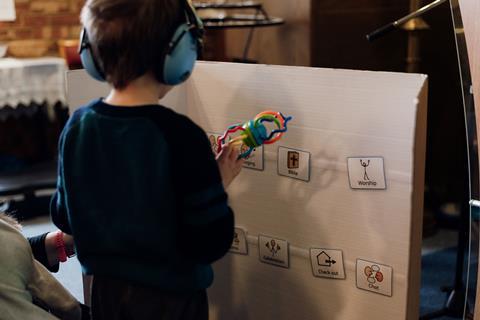
On a practical level we can try and put in place as much preparation as possible. Letting our child/ren know through our calendar, through talking about church, and through reminding them before we go. We can give detailed information which helps e.g. “we’re going to walk there and we’ll leave at 10:00, when we get there we’ll sign you in for your group and you can find your friend.” It may be that the first bit of church is challenging for your child or young person, you could take a specific activity to help at this time. It may be that your child struggles with the environment, perhaps the people, the loud noises. You can think about where you might sit and what might help (e.g. ear defenders may help your child or young person feel safer if it’s a bit too noisy).
Can you spare 5 minutes to help Premier NexGen? Answering this short survey will help us make our great content for Christian parents even better
2. Safe spaces, safe people
The more we can support our children to build connections with individuals who may become key safe people the better. For example, we can introduce them to key adults or children they may connect with by bringing a game or something they might like to show others. We can also support our child to find safe spaces within church. This might be exploring with the kids and youth pastor a corner/ sofa or space that can be familiar. It might mean sitting in the same seats each week so they’re familiar.
3. Sensory processing
As an occupational therapist I think a lot about sensory processing. We know that there are lots of things that we can do to help us feel more regulated and able to participate within activities. Regulation activities often work in combination with other strategies in order to set up as much success as possible for our children and young people. The most regulating activities are movement activities which involve our proprioceptive sense. This sense enables us to know where our body is in space. The more proprioceptive input we receive, the more grounded we feel. Movement activities which put pressure through our joints give this feedback to our body. On a Sunday this could include:
- Bouncing on a trampoline
- Walking, cycling, or scooting to church
- Having a crunchy snack like an apple or carrot sticks on the way or during the service
- Drinking from a water bottle with a tricky straw
- Helping pick up and carry bibles or move chairs
- Sitting on a gym ball
- Running or playing football
- Having a plank competition
4. Being with
When things are difficult the best thing we can do for our children is to ‘be with’ them in what they’re feeling. The more we try to acknowledge our children’s feelings the more seen they feel. For example, saying ‘I know you’re finding it tricky this morning, I think you’re feeling a bit wobbly and that you want me close.’ May help our child to feel more understood in the moment.
5. Coming back to love
Sometimes it will go well and sometimes it will be more challenging. I remember one incident where a Mum had split her lip just before she walked into church as a result of taking something off her daughter in the car before they went in. Sometimes we have moments where we feel overwhelmed and it’s difficult to keep going and face other people. Sometimes we have to give up for that day and turn around and go back home. Whatever our situation we can always come back to love. Many resources help to explain attachment trauma and the gaps it can leave in the wall of security that each of us need to thrive. When we remember that our children are having to manage those gaps constantly and may constantly try and push us away, it can help us to remember to come back to love.
Read more:
Rethinking Christian hospitality for families who can’t do shared meals
Why I’m worried that SEND changes will push more children through the cracks
We have an incredible heavenly Father who loves us with an everlasting love and wants us to know his presence surrounding us. He fills us with love overflowing that we can pour into our children. Helping our children and young people to know that they’re always loved, no matter what, no matter how something has gone, is so important. We can do this with our words, through giving our children the things that help them feel safe, through writing them notes, through positive affirmation.
We can trust our heavenly Father with our wonderful children. As we put in place practical strategies which help them we know that God is always at work in their lives.
Resources
- · Growing Hope – Occupational therapy resources & accessibility training
- · Join the Dots – helping churches to be trauma informed
- · Trauma informed churches – helping churches to be trauma informed
- · Beacon House -trauma Resources
- · When Dreams Change Training – Facilitator training to support parents and carers when their hopes and dreams change because of their children’s needs.