



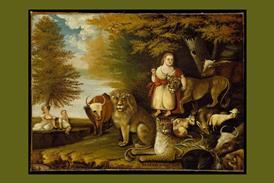






Robin Barfield shows how, whether theoretical or deeply personal, children’s questions about sin and heaven invite us to explore the mystery and the mercy of God together

When we talk about sin with children, they often want to pull it apart and consider the issue from different angles. Where did it come from? Is there a way of avoiding it? Is it as fair as it appears? How we answer these types of questions can be the difference between how a child conceptualises who God is, not only whether He is fair but whether He is gracious and loving.
There may be several reasons a child asks a question like this. It may be purely theoretical – ‘how would God act if this were the case?’ – or it may relate to something which has troubled them, such as the loss of a sibling or the child of someone they know. Either way, their way of asking may be very matter-of-fact, so it is always important to pause for a moment and pray for wisdom.
it can be okay to say to a child, carefully, that you find this a hard question
I have been asked this question a number of times in school lessons and in club situations, as well as by my own children. Each time I have had to draw a long breath as I prayed, asking for wisdom to know how to help this particular child in their search for meaning. These are precious mysteries we are exploring together.
This may also be a question which troubles you personally, and you may find it hard to contemplate as you answer. That’s ok. And it can be okay to say to a child, carefully, that you find this a hard question, both personally and theologically.
Read more:
Will we remember our earthly lives in heaven?
What was Jesus doing on Easter Saturday?
There are a number of ways of answering the question, depending on what you think the Bible says about a child.
- You may believe that children are innocent, and therefore, there is no issue in answering ‘yes’ immediately. A young baby has not actively sinned, and therefore, it is not counted against them. Jesus welcomes children (Matthew 18:1-6), and so he welcomes babies into heaven.
- You may believe that, following verses such as Psalm 51:5, all humans are born in sin. This is often called ‘original sin’ and gives all of us a need for Jesus’ forgiveness. The issue then is how pre-verbal children might express faith. Historically, many who hold to God’s election (Ephesians 1:4-5) have seen infant mortality as a sign of God’s election. Some have applied this only to infants of believing parents, but many have seen this as affecting all children who die in infancy, with a generosity of God’s grace. This is personally what I would hold. Others would say, ‘perhaps, we cannot know exactly’, but they would express hope for the child.
- I have known some Christians who would say, ‘certainly not’. Salvation requires a cognitive response which an infant cannot give. This, to me, seems inconsistent with Scripture and with how wise Christians throughout history have responded.
Wherever we stand on these issues, we can assure a child that God is a fair God, He will judge us based on what we know, and He is a loving God who expressed this in sending His own Son in the person of Jesus Christ.
It is a good thing, even with this question, to say ‘I don’t know for sure, but I do know this…’
A question like this is an opportunity to speak of the loving kindness of our God, to show that He is not capricious or arbitrary in His decisions, but is a loving, faithful and covenantal God who has committed Himself to us for our good. We can do this without having all the answers. It is a good thing, even with this question, to say ‘I don’t know for sure, but I do know this…’
This is not a theoretical question, even if it appears so. We are sharing in this grand plan of God together with many others in His church, and each of us matters to Him. To explore those beautiful truths with a child is a privilege and a joy. Yet with questions such as this, it reminds us of the awe-inspiring privilege too.