










Charles Merritt loved this sweeping new adaptation of Homer’s classic, which blends stunning visuals and mythic adventure with themes of hospitality, justice, and the search for true belonging, offering plenty for Christian families to discuss after the credits roll
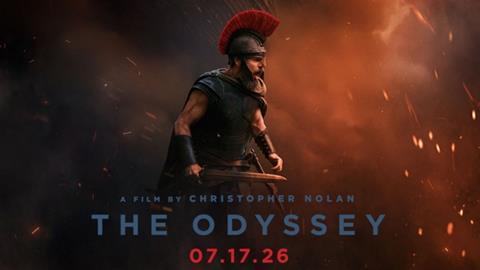
Film: The Odyssey
Age rating: 15
Runtime: 172 minutes
See this if you liked: Oppenheimer, Gladiator
The Odyssey lives up to the hype
Synopsis:
Odysseus finds himself on an epically long journey home, whilst his son desperately searches for him before it’s too late and his kingdom falls into the wrong hands.
Review:
It’s the biggest film of the year so far, and absolutely the longest, but The Odyssey lives up to the hype.
With a nearly three-hour runtime, you’d be forgiven for thinking that you’d feel it, but the pace and the narrative move so quickly that the film never really allows you a moment to breathe before you’re thrown into the next insane sequence of events. It didn’t feel like three hours and yet by the end of the film I was utterly exhausted and felt as though I had been on Odysseus’ several year journey myself.
The cast is incredibly strong with great performances throughout. Stand out roles go to Samantha Morton as Circe, who really steals the show in an unforgettably disturbing scene (if you know your Greek mythology, you’ll know what I’m referring to), and Robert Pattinson who does such a good job as a snivelling, menacing villain that you’re rooting for his downfall for the whole film.
What makes the film so tense is not just the masterful directing of Sir Christopher Nolan but the thumping score of Ludwig Göransson
Visually, it’s stunning. I went to see it in IMAX as this is the first film to be entirely shot in the format and it really was worth the price of the ticket. Seeing it at the cinema, on the biggest screen you can, is absolutely the way to see this film, especially the cyclops sequence, as you really feel the scale and size of the creature in comparison to Odysseus and his men.
What makes the film so tense is not just the masterful directing of Sir Christopher Nolan but the thumping score of Ludwig Göransson (fast becoming one of the best composers of the modern age of cinema). Whether it be relentless drumming or magical flutes, the score elevated every scene so effectively.
There is so much in this film that you’ll hopefully forgive me that I can’t cover it all. In truth, every time I go to write something, I realise that there was another brilliant moment I’d forgotten about. I could easily write a review as long as Homer’s Odyssey itself, but I shall restrain myself from doing so.
Faith thoughts:
There’s an enormous amount to unpack here that it’d be incredibly easy to create an entire Bible study around the film (something I’d love to do if I had the time…).
Perhaps what is most interesting about The Odyssey is Nolan’s use of ‘Zeus’ law’, which follows the Golden Rule – treat others as you would wish to be treated. This, from doing some digging on the internet, appears to be completely new and added to the source material. There appears to be no such thing as ‘Zeus’ law’, neither in the text nor in Ancient Greek history. Why did Nolan use it then?
Hospitality is at the heart of the film. Whilst Odysseus is away from home, presumed dead by many, his house is filled with suitors, seeking to marry his wife, Penelope. They feast every night, eating and drinking all their host’s supplies.
if I was to give my verdict on what Nolan’s Odyssey is about, I’d make the argument that it’s about humanity losing its way and giving in to the nature of sin
Beggars also seek shelter in their home but are mistreated and scorned by the wealthier suitors. Telemachus, Odysseus’ son played by Tom Holland, often refers to ‘Zeus’ law’ and more specifically states that they should treat every stranger with respect as they may be the gods in disguise. This, by all accounts, is a little truer to the beliefs of the Ancient Greeks – treating strangers and visitors with kindness was culturally expected in fear of upsetting Zeus.
Seeing God in a stranger’s eyes is not a foreign concept to us as Christians. Jesus mentions this in Matthew 25:35-40 and reminds us to love our neighbours as we love ourselves in Mark 12:31.
Nolan’s application of Christian theology into Greek mythology is certainly intriguing. Is it so the concept of generous hospitality makes it easier to chew? Is it to make Greek myth feel more relevant to a modern-day audience?
I would argue that loving your neighbour and seeing God in a stranger’s eyes is actually very far from where we are as a society now, with Christianity no longer being a common language or way of life. Our response to immigrants and refugees proves as much. The divisions and infighting in culture and politics equally demonstrate that we have lost our way when it comes to loving our neighbour. And it’s not just the world that has fallen victim to this; it even exists in the Church.
Read more:
Girls by Freya India is the wake-up call every Christian parent needs
Indeed, if I was to give my verdict on what Nolan’s Odyssey is about, I’d make the argument that it’s about humanity losing its way and giving in to the nature of sin.
Empires rise and fall. The Greek Empire. The Roman Empire. The British Empire. And, very likely, the American Empire.
All of these empires start out with ideals but fall to their own traps of greed and power. That doesn’t even cover the atrocious acts done in the name of empires. Countless lives lost and cultures erased in the name of establishing something that cannot feasibly last.
Have you ever noticed that Jesus refers to God’s domain as the Kingdom of God not the Empire of God? Jesus was preaching in a time of the Roman Empire and yet does not use the term Emperor to describe himself but King. Kingdoms are a single, sovereign nations. Empires sprawl across and capture multiple nations, existing in a divided and oppressed state.
The Kingdom of God is united, serving in one purpose, led by a King who cares deeply and intimately for His people, not distant and removed, and will last for eternity unlike the empires before it.























No comments yet