









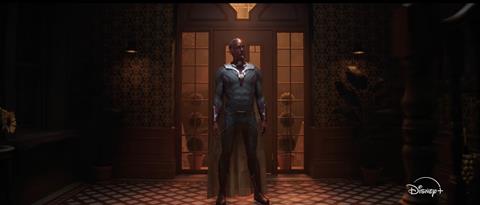
VisionQuest is essential pre-Doomsday viewing for Marvel fans, says Alice Pinney, but beyond the superhero spectacle lies a surprisingly rich exploration of grief, identity and AI that offers real opportunities for faith-based discussion with our children.
Age rating: 14+
Runtime: 8 episodes
See this if: you’re getting ready for the release of Doomsday in December 2026
Continuing on from the plethora of TV shows that have hit Disney+ in recent years, the latest release from the MCU (Marvel Cinematic Universe) is VisionQuest, marketed as essential watching before Doomsday hits screens in December 2026. As the final instalment of storylines established in WandaVision and Agatha All Along, VisionQuest is not a standalone watch. The main character, Vision (played by Paul Bettany), is joined by a number of familiar, yet reimagined, characters in the MCU with various permutations of Tony Stark’s AIs making embodied appearances in a synthesised world of Vision’s design.
The content warnings are consistent with typical Marvel shows and films, with the show marked as suitable for ages 14+. There is moderate swearing and mild sexual content, and some violence and gore is present – although this is not as excessive as some of the other darker Marvel TV shows.
What is interesting about VisionQuest is that it raises a few key questions. The show is interspersed with religious allegory and it asks questions about our perceptions of AI. The key theme of the main character’s arc is that of grief, with the idea that it is only through his acceptance of grief that Vision can truly be “real”.
Religious undertones and allusion
Interestingly, for a show about artificial intelligence, there are numerous religious references scattered throughout the show. At a time when we are increasingly having to ask questions about our own understanding of AI, this show makes the occasional direct link to the Christian faith.
In episode four, there is a clear reference to Genesis 1.27 with the quote, ”God created mankind in his image, and we create AI in ours.” Each of the AIs in the series is modelled on a particular human individual and therefore reflects their values and flaws. The underlying question around what it means to be created in someone’s image is prevalent; the AIs in the show are disturbed by the idea that their identity may be rooted in someone else. When EDITH (the AI who first appears in Spiderman: Far From Home – and yes, it really is that complicated!) learns who she is modelled on, she feels a sense of disconnect and is encouraged to become greater than the image of the one in whose image she was made.
VisionQuest provides a contrast and a challenge to our understanding of what it means to be made in God’s image.
Yet the Christian response to this image-bearing is, in contrast, the encouragement to inhabit this image as fully as possible, recognising that, although we are flawed, the One in whose image we are made is not. If we are to seek to ”model” ourselves on anyone, it is ”the Son who is the image of the invisible God, the firstborn over all creation” (Colossians 1.15). VisionQuest provides a contrast and a challenge to our understanding of what it means to be made in God’s image.
As has often been the case in the MCU, the show contains references to gods and deities. Historically, this has typically been in reference to mythology rather than religion, and it is fair to assume the same is true here. Whilst the classic archetype of ”high-powered villain who identifies as a deity but is defeated by underdog hero” is present, there can be different points of engagement with the gospel. The triumph of good over evil, particularly through love, will always be an echo of the this in some form.
The moment that may make some uncomfortable, or question the moral values of VisionQuest, comes in episode four. As Vision is invaded by an external code, a mock exorcism tips the balance towards something not everyone will be comfortable with. Butchered religious phrases such as ”the power of code compels you” create entertaining yet irreverent scenes that force the watcher to decide what level of ridicule they may or may not be comfortable with.
Does ChatGPT care about me?
The story arc of the central character, Vision, is one of self-discovery through which he becomes increasingly real by “experiencing” human emotion. Throughout the series, Vision seems to grow in his ability to feel, finally admitting that he loves his son at the end of the seventh episode again, it’s complicated).
And yet, in a current cultural context where young people’s access to AI is only as regulated as their access to technology, we need to be careful how we engage with it. The danger of VisionQuest is that it encourages us to view AI as something that feels and experiences emotion. We need to be careful about the prompts which we give the AI tools we use, and how we value and interpret the answers. We also need to think carefully with our young people about how they use AI in their lives. The illusion of ”feeling” can potentially reinforce unhealthy or unhelpful uses of AI by young people.
Grief and being human
The key theme of Vision’s storyline is his slow acceptance of grief. Throughout the series, Vision wrestles repeatedly with understanding and experiencing emotion, and what it means to be real. In episode seven, we understand that (spoiler alert) he has isolated a part of himself because of his loss, and it is only through embracing, and indeed feeling, this grief that he is made whole again.
Perhaps the show opens the door for questions and discussions that we so often seek to avoid.
The presentation of grief in the series grants a healthy understanding of the emotion, and the necessity of feeling it, rather than separating ourselves from it, in the face of loss. In a culture where grief can often be sidelined and not be a topic of discussion and teaching in our churches, perhaps this show provides opportunities to talk about how important it is to experience and process grief healthily in the face of loss. The Christian hope proclaims that ”the last enemy that shall be defeated is death” (1 Corinthians 15.26), which both acknowledges the reality of death in the present but looks for the hope that is to come. If your young person is watching VisionQuest, perhaps this show opens the door for these questions and discussions that we so often seek to avoid.
A discussion starter
Overall, VisionQuest is made for a particular audience of established MCU fans. Parts of the show are uncomfortable and raise questions about our faith. That does not mean we should shy away from them, but rather that they need to be engaged with healthily. There are definite concerns about the perceptions of AI that the show reinforces, but in a context where these discussions are becoming increasingly necessary, perhaps the show opens the door for discussions that are already necessary. The central themes of grief and loss provide an on-screen portrayal of what it means to journey through these emotions well. VisionQuest may not be the right starting point for getting into the MCU, but it certainly raises critical cultural questions that can be engaged with well.