








In a world of TikTok news and heated debates, Nesu Kwaramba believes that Christian parents have a unique opportunity to help children become thoughtful, gracious, and hope-filled citizens
For some months now, we’ve been running a segment called ‘Unplugged’ during one of our weekday sessions at our youth club. During Unplugged, with phones switched off and gentle instrumental music playing in the background, we choose to reflect on a particular idea or thought for a few moments, inviting young people to share their thoughts and allow their often-busy minds to slow down and consider what is shaping their thinking. It’s a healing space; and it is intended to be a detox from a saturated and charged online arena. Conversations have at times been so fruitful and helpful for the young people (we thank God!).
Many in the youth group I help with get their news from the Tik Tok pages of news outlets like the Sun or the Daily Mail, or from GB News, or their google feed
Recently, I brought a newspaper to the session for a discussion on global responsibility and was stunned by how the exchange exploded when we talked about the recent local elections in May. When one young person – characteristically timid and reserved – mentioned that he supported Reform UK, it all kicked off! He was accused of being a racist and three girls stormed out of the room. I was delighted to see this usually self-contained teenager share his perspective quite confidently (and defend it so calmly), but I was displeased to witness the level of vitriol he was subjected to – quite apart from whether I agreed with his political opinion. So much for this being a healing space! Or maybe this is just what we needed as a group, to have this unyielding and unaccommodating attitude – which mirrors much of what can be seen at present in society – unmasked.
Deep division, daily
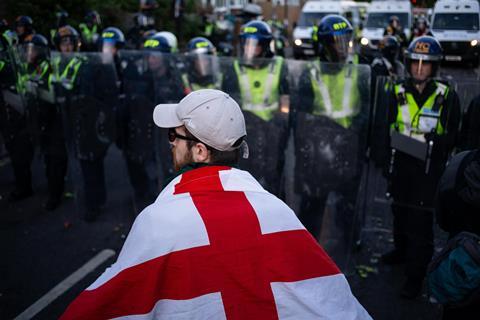
‘Polarised times’ is how our current cultural moment was described at the recent annual, Youthscape/ St Mellitus College lecture. This lecture came two days after thousands gathered in the UK’s capital for two opposing marches. The Tommy Robinson’s Unite the Kingdom march, and the Nakba 78 pro-Palestine march both took place on 16th of May. The former, a glaring exhibition of the gaining momentum of far-right politics; the latter an outcry against the perceived dangers of the former – as well as a reminder of the diverse demographic that that now forms the United Kingdom, many of whom come from distant lands they still hold close.
perhaps it is unremarkable that young people would mirror the corrosive and polemic attitudes that surround controversial topics
In reality, the marches function as a microcosm of the global cultural landscape at large – a world that is now characterised by extremely strong, divisive opinions. This is all fuelled by the ease with which unfiltered thoughts can be broadcast publicly so that young people are constantly besieged by opinions online.
Many in the youth group I help with get their news from the Tik Tok pages of news outlets like the Sun or the Daily Mail, or from GB News, or their google feed. So, perhaps it is unremarkable that young people would mirror the corrosive and polemic attitudes that surround controversial topics. I think in these times, it’s difficult for us all to cultivate atmospheres of healthy dialogue. Yet, the Bible indicates that our words and works may be the very way our cities are either built up or torn down.
Read more:
5 things Christian parents can do about antisemitism
Iran War: How Christian parents can help kids cope with bad news in a troubled world
Christian parents need to raise their children to be politically active - here’s why and how
Good citizenship, great cities
Proverbs 11:11 declares that ‘[u]pright citizens are good for a city and make it prosper, but the talk of the wicked tears it apart.’ So, our words can either bring life to our communities or death. In a world where many people find it fashionable to deride the government and lambast others holding opposing views, and where complaining is the hue that colours our societies, what difference would it make if we spoke well of our cities by outlining what governments are doing right and what we do appreciate about our communities?
What if young people were taught that God wants his citizens of heaven (Philippians 3:20) to be good citizens on earth?
What if young people were taught to commit (Isaiah 62:5 emphasis added) to cities instead of taking up permanent residence at Complaint Avenue and Criticism Road? What if, in dialogue with people on the other side of the political spectrum, we would heed the Lord’s advice not ‘think [we] know it all!’ (Romans 12:16)? What if we learned to circumvent folly and shame by not answering a matter before we’ve given it a fair hearing and understood more about why people believe what they believe? (Proverbs 18:13; Proverbs 19:2). Moreover, what if we sought to work for the peace and prosperity of the city where God has placed us – whether it is our native land or not – as the Lord requires (Jeremiah 29:7)?
What if young people were taught that God wants his citizens of heaven (Philippians 3:20) to be good citizens on earth? That we are called to respect authority, pay our taxes and ‘give to everyone what we owe them’ (Romans 13:1-7). We are not required to pretend those in authority are ruling justly when they aren’t (Proverbs 29:2); and we are required to speak up, and act against injustice (Isaiah 58:6-7; Luke 4:18-19), as well as to pray for God’s intervention in our communities and regions (Jeremiah 29:7; Habakkuk 1; Matthew 6:10) – after all only God can bring true justice (Hosea 14:3 ). But there is a way to share our perspectives and make a difference in a godly way.
5 ways to help your children becomes good citizens
The outworking of a good grasp of our heavenly citizenship is being good citizens of the countries we are called to live in (Matthew 22:17-21). And in these polarised times, parents can encourage their children to be good citizens by encouraging them to:
- Listen well to others with differing views and present their own views passionately, but respectfully (Isaiah 59:15-17; 1 Peter 2:17)
- Pray for God to intervene in regional and world affairs
- Partake in acts of mercy
- Respect authorities, pay taxes and vote
- Aspire to occupy positions of political influence if they feel so called (Proverbs 29:2; Esther 4:14).





















No comments yet