








The government’s plan to introduce vocational GCSEs from 2029 has sparked fresh debate about how we value different kinds of learning. Andrea Zanin reflects honestly on her own prejudices, the reality of inequality in education, and what it really means to help every child flourish in their God-given identities — desk or no desk.
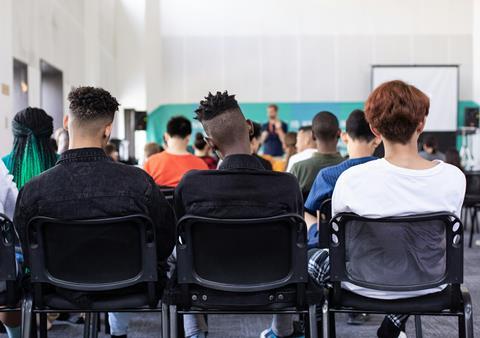
Children are different. People are different. We think differently, learn differently and assimilate information in ways uniquely shaped by our God-breathed blend of personality, temperament and genetics. This is not news to most of us, right? So isn’t it interesting that we simply accept a system that says the best way to learn is at a desk – from the age of four until the age of 18 – to be taught and tested. Or perhaps more controversially: taught to be tested.
This is in no way a slight against the great privilege of education. And you’re right, it’s not all desk-and-test. When our young children go to school they play and socialise, there are school outings and residentials, they engage in projects, workshops and physical activity. However, as a mum of five kids, I’ve been at the school gate for a long time (my oldest child is almost 17, and the littlest is eight) and common perspective seems to be that there is a big disconnect between primary and secondary school learning.
As students climb the ranks in the school system, testing accelerates, culminating in the pinnacle of all future hope – the 6-, 8- and 12- markers of year 11 GCSEs. Stray from the path and wave goodbye to A-levels, university and a job.
But what if you’re just not built that way?
What if you’re a path defier? And the road less travelled is your preferred route?
Surely there must be an alternative way of assessing talent and igniting passion? (Assuming that’s what school is about.) Or is academia the only way? For some, it’s natural and beautiful, but for others it’s taxing and, sometimes, quite dull.
Is it time to start thinking outside of the box? Especially in the wake of AI, which has successfully managed to unsettle not only the relevance of what is taught at school but the job market, too. Who knows what work could look like ten years from now?
So many questions.
The easier option – or the only one?
One answer currently on the table is the government’s new vocational GCSEs, which are to be introduced from 2029 alongside existing core academic subjects in England.
As a parent, how do you feel about this?
I’m going to be honest. Whilst I think it’s a great idea that could give students more opportunity to explore their interests, and flourish in their skills and natural giftings, I am barely coming to terms with conversations I’m having with my own children about replacing A-levels with more practical BTEC options – and not going to university (and putting themselves in 40K debt). Which is forcing me to take a good, hard look at my own prejudices and priorities.
There is a large body of research that consistently shows that BTECs and vocational education are disproportionately taken by students from lower socio-economic and working-class backgrounds. Why? Because lack of resource makes everything harder – financial stress, social isolation and uncertainty can affect parents’ mental and emotional wellbeing, reducing their capacity to build strong relationships with their children – in turn, impacting children’s ability to cope with life’s challenges.
It’s is forcing me to take a good, hard look at my own prejudices and priorities.
Imagine, as a parent, spending your days fending off the either/or of food, heating and housing. Or working multiple jobs purely to stay on top of bills and debt – not because you love to work and contribute, or are living your dream as an entrepreneur. Rather, you’re exhausted, you’ll probably have to skip dinner so your children can eat, and you feel guilty because you can’t afford new school shoes and it’s freezing inside. And then your child needs help with homework and all you can think about is how you’re going to get through the day without giving up entirely.
It’s not like this for everyone facing disadvantages, but poorer mental health, reduced parental confidence, strained relationships and conflict in the home are often natural consequences of massive stress. And there are no private tutors or access to better resourced schools, or even parenting support and community, that students from wealthier backgrounds will benefit from.
It’s for all these reasons that students from low income/low support contexts are statistically less likely to achieve the top GCSE results required to enter traditional A-level schools. When that happens, they are funnelled into more practical vocational pathways, which do not typically require top results. For this reason, BTECs have been stigmatised as the “easier option”.
Apples and oranges
But this is not a helpful diagnosis of what, in effect, are two very different pathways to excellence. Comparing traditional A-levels with vocational courses is like comparing apples and oranges – both fruit but entirely different in taste, texture and experience. Some people prefer apples and some oranges, and we don’t think any lesser of them.
In a speech arguing for parity between technical and academic careers, Prime Minister Andy Burnham made a bold comment: “From today, Britain will value the hard hat as much as the graduation cap.” Whilst the “from today” but might be a stretch, what he’s actually saying is that we are all of equal value no matter what job we do. Just as the apostle Paul says in 1 Corinthians: every person has value and a role to play, even though those roles are different. Just as a body needs hands, feet, eyes, ears and other parts, God has given different gifts, abilities and responsibilities to different people. Not only should we acknowledge and respect one another’s traits but “Those members of the body which we think to be less honourable, on these we bestow greater honour” (12:23) – it’s God’s glorious upside-down kingdom.
Sometimes it’s really hard to be in the world and not of it. Sometimes it’s really hard to be consistent in our morality. Why is it okay for Sally’s kid to not go to university because she’ll be happy doing hairdressing and that’s so great. But my kid must go – because that’s how you show to the world that you’re intelligent and hard-working and have good parents. Even as I write it down it sounds ridiculous. It’s a lie.
It’s God’s glorious upside-down kingdom.
So, I say to our kids – love the Lord, be more like Jesus, treat people with kindness, figure out what you love and go for it. Academia (desks and tests) is not made for everyone. Do your best. Whilst secretly hoping they go to university? That’s not what the Bible says.
“There are differences of ministries, but the same Lord. And there are diversities of activities, but it is the same God who works all in all.” (1 Corinthians 12:5-6)
My own human failures aside, there is a very real possibility that the utopia of vocational courses at GCSE level will overwhelm an already existing divide between “rich” and “poor” – unless there is a general societal attitude shift. And probably an entire system shift. Of these two options there is one that we have more control over.
It’s one thing to say that we celebrate our differences, but it’s another thing to put this into action. Ultimately, I want my children to be light and salt wherever God takes them – even if it’s not English Literature. His plans are bigger and better than mine – by a mile – and if school can adapt to give them the space and encouragement to pursue what feels more natural to the way they enjoy life and express their faith, then let’s do it!