




When Mark Buchanan stood on the hill where Jesus was crucified, he got thinking about the centurion who realised that Jesus is the Son of God – and it sparked an idea. Letters from Gaius was born, an imaginative and biblically grounded Advent devotional designed to bring families together around the nativity story.
When I was ten, something went wrong with my knee and I was off school for a few months. My mum had been a school teacher and she gave me lessons at home. The Living Bible paraphrase had just been published and, as a break from lessons, Mum would read me the Old Testament stories of King David and his mighty men.
I was hooked. I loved the adventure of it all, but what really stuck with me was the idea of a God who actually interacted with His people. There was good and evil, triumph and disaster. Battles were won. Battles were lost. But through it all, God was always there. There was always a plan and, when human strength ran out, God’s supernatural power would take over.
I didn’t realise it at the time, but those stories shaped my view of God and built the foundation for my journey through life with Him.
Shared storytelling
Stories are food for the imagination. They give us space to play with ideas and to imagine how we would engage with the world they build. It doesn’t feel like we are being tested or that there are right and wrong answers. It’s just that, sometimes, we end up thinking differently because of something we encountered in the story.
Even back then our world was increasingly dominated by secular ideology, but I had a firm foundation to stand on. I also had a strong bond with my parents that kept me safe. Nowadays, the stakes are even higher. Social media and our education system are infested with ungodly ideas and attitudes.
We end up thinking differently because of something we encountered in the story.
As parents, we need to be able to counter those unbiblical ideas. But often, it is more effective to simply model the positive alternative. Exploring the Bible with our kids, through reading and storytelling together, is an incredibly effective way to do this.
Needless to say, when my own daughters arrived, storytelling became an important part of our relationship. We were often separated by timezones and distance but, even over video chat, shared storytelling helped build and maintain the bond between us.
Standing on Golgotha
My travels regularly took me to the Middle East and I found myself standing in many of the places where the stories my mum read to me, all those years ago, took place. They are ruins now, but those piles of stones, where Bible characters lived and died, provided a hook for my imagination to hang those stories on. The more I travelled, the more fascinated I became with biblical history and archaeology.
During one of those trips, I visited a place that many believe to be Golgotha – the place where Jesus was crucified. The verse from Mark 15:39 sprang to mind. After watching Jesus die, the centurion at the cross exclaims: “Surely this man was the Son of God!” I remember thinking to myself, “I wonder what happened to him after that?” I started to imagine him becoming a follower of Jesus and trying to piece together the events that led to the birth of Jesus and the crucifixion he oversaw.
We are invited to join Gaius as he explores the people, places, prophecies and politics that frame the nativity story.
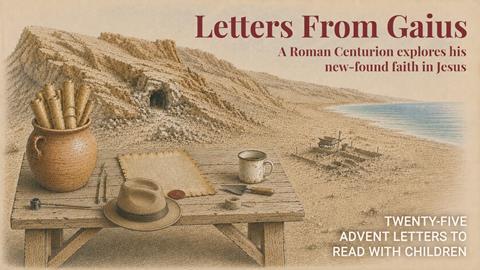
Letters from Gaius was born out of that idea. They are a fictional account of the centurion – Gaius’ exploration of his new-found faith. We get to follow his journey as we read the letters he wrote to his son, Lucius, that were discovered in a cave at Qumran. Gaius is an outsider, shaped by the Roman occupation. He is sceptical, curious and down-to-earth. We are invited to join him as he explores the people, places, prophecies and politics that frame the nativity story.
Interactive and imaginative
The resource contains 25 letters – one for each day of Advent and one for Christmas Day. Each one features the translated papyrus of a letter from Gaius to Lucius, with notes, maps, drawings and Bible references drawn in the margins by the professor who discovered them.
The idea is to hide one each day for the children of the house to find. Then it is time to sit and read together. Holes in the papyrus mean that some words are incomplete or missing, so there is fun to be had, guessing what should be there. Every letter is biblically and historically accurate, and each of them points to at least one Bible passage that is relevant to the nativity story.
They are designed to promote meaningful, shared reading experiences between adults and children. They allow those children to engage with the truths of the Bible using their imaginations as well as their minds. I hope that they will find the Lord for themselves in the process.
Letters from Gaius costs £39.99 from We Are Fair Trade. Order by 23 November for Advent delivery, or request a free sample letter at www.lettersfromgaius.com.