









Too many children with additional support needs have gone unseen in faith settings. Scripture Union Scotland’s new resource Who Is Jesus? is the first of its kind in the Scottish curriculum – and it’s free for schools, churches and families to use.
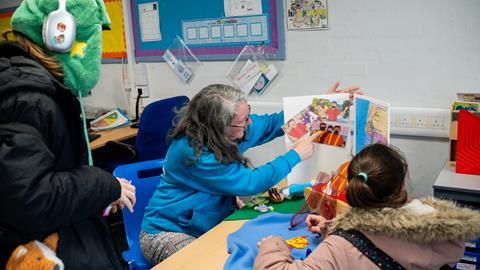
Every child needs to encounter Jesus. However, that has not always been easy for children with additional support needs. Here’s how that’s starting to change.
Every church wants to say, “You belong here.”
The challenge is that belonging requires more than good intentions – it requires understanding, preparation and resources that many churches have not had access to.
At Scripture Union Scotland, we believe every child should have the opportunity to explore and respond to the message of Jesus. But we’ve also had to ask ourselves an uncomfortable question: have we always made that possible?
Room for every child
At Scripture Union Scotland, we create digital resources to support children and young people explore the Bible and respond to the significance of Jesus. However, there was one key area we were missing.
There is a gap from the church and Christian organisations when it comes to creating children and youth resources designed specifically for children with additional support needs. As a result, there are parents left feeling that their children go unseen.
It’s not that people don’t want to be inclusive, but there’s a lack of awareness about what that means.
I think it should go without saying that churches did not set out to exclude children with additional support needs from exploring faith. “It’s not that the desire is not there,” says Elaine Tait, our ASN Development Coordinator at SU Scotland. “It’s not that people don’t want to be inclusive, but there’s a lack of awareness about what that means.”
Within Scottish schools today, 43% of pupils are recorded as having additional support needs. However, we have spoken to parents who repeatedly tell us the same story – the resources and planning that inclusion requires do not always align with this reality. Children who process the world differently are often given early years or first level materials adapted for their group.
While teachers, church workers and parents genuinely want to try their hardest to be inclusive, it can be difficult when available resources are limited.
Every child is made in the image of God. But as a church, we need to be asking whether we have always made room for every child to encounter Him.
What inclusive actually looks like
Real inclusion isn’t about making faith simpler – it’s about making participation possible.
For children with additional support needs, engagement is often sensory, and predictability helps. A quiet corner, fidget tool or wobble cushion can make staying present possible, but every child is different and we first need to listen to their needs.
I’ve found the parallel between this type of inclusive engagement and how Jesus taught particularly striking. Jesus pointed to things people could see and smell and touch, and used imagery of yeast and seeds. He met people in the middle of their ordinary, sensory, embodied lives. Elaine puts it simply: “Once you see scripture through this lens, you can’t not see it.”
Inclusive faith education isn’t a ”workaround”. It may, in fact, be the most faithful and authentic way of teaching there is.
Something built with your child in mind
Parents of children with additional support needs already know that systems are rarely designed with their child in mind. You’ve sat in meetings, chased calls and fought for provisions that should already exist, carrying the weight of constantly pushing. SU Scotland asked a different question: how can we create resources that fit these children instead?
Who Is Jesus? is SU Scotland’s new resource. It’s the first of its kind in the Scottish curriculum and we have been so excited about this launch.
Young people with additional support needs are entitled to the same intellectual and spiritual development as every other child.
Elaine created seven lessons specifically for secondary pupils with additional support needs, in any setting, designed for learners who access the curriculum differently.
Lessons are tactile and multi-sensory, with illustrations commissioned to suit teenagers. But it does more than teach Bible stories: it gives young people tools to ask questions, think critically and make decisions. We recognise that young people with additional support needs are entitled to the same intellectual and spiritual development as every other child.
“These young people are leaving school in a few years’ time,” Elaine says. “They are vulnerable, and likely to be vulnerable adults – but we can give them skills which mean they’re not as vulnerable as they would have been.”
What this means if your child isn’t in a school using it
The resource is designed for schools, however that doesn’t mean it only belongs in this setting.
Who Is Jesus? is freely available, and the lessons, activities and materials are accessible enough that churches, homeschooling families and community groups can draw on them, too.
For many parents, what matters most is that somebody thought about your child before they entered the room, asked what they needed to participate fully, and built the answer.
Your child does not need to become a different kind of learner before they are welcome in God’s story.
A note to parents who are tired
If you’re carrying the exhaustion of raising a child with additional support needs, SU Scotland wants to say something to you directly: we see the grief in that. We see what it costs to keep advocating. We see the gap between what should be in place and what actually is.
We can’t close every gap. But we can keep asking what it takes to make sure every child has the chance to explore the Bible and respond to the significance of Jesus.
Every child is made in the image of God. And no child should be left out of the greatest story ever told.
You can access Who Is Jesus? free here.



















No comments yet